Shopify Native Search: What 9 Mid-Market Fashion Stores Actually Return in 2026
Shopify Native search tested on 9 mid-market fashion stores. 'Wedding guest dress' returned zero on six. The intent-vocabulary gap and the fix.
On this page (6 sections)
On one of the nine mid-market fashion stores I tested, the query "wedding guest dress" returned zero results.
The same catalogue, queried for "occasion dress", returned thirty-eight.
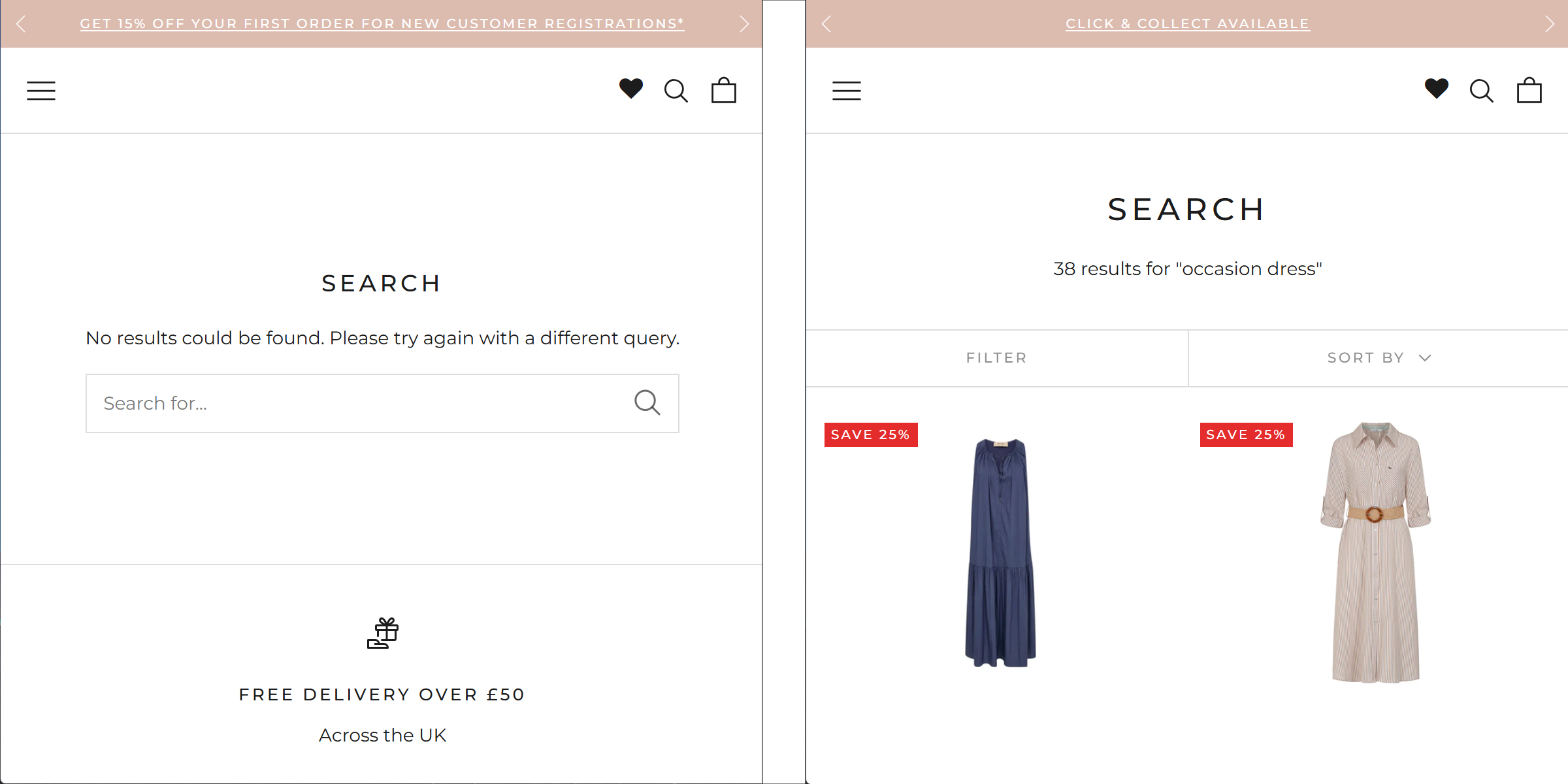
This is not a story about a broken store. The store in question runs Shopify Native search with Search & Discovery installed. So do all nine of the stores in this study. The catalogue stocks dozens of dresses that any human merchandiser would describe as wedding guest dresses. The engine simply does not bridge the intent phrase to the catalogue's vocabulary.
This post is the long version of what I found across all nine. It is not a teardown of Shopify Native. The engine has gained real ground in the last eighteen months and on some queries it is now competent. It is a measured account of where Shopify Native still leaves fashion merchants exposed in 2026, and where the gap matters most.
What "Shopify Native" search actually is in 2026
Shopify Native search has two layers worth naming, because they get conflated.
The first is the engine that powers the storefront search bar and the predictive search dropdown by default on every Shopify store. Since 2024 this engine has been a semantic search system internally branded Vantage, which Shopify rolled out as the default semantic layer for Online Store 2.0 themes. It runs on every plan, including Basic.
The second is the Search & Discovery app published by Shopify. This is a free admin-side tool that lets a merchant configure synonym groups, boost or bury individual products, and shape the filter set on storefront search and collection pages. It does not replace the engine. It sits on top of it and configures it.
So when this post says "Shopify Native search", that is the shorthand for: the Vantage semantic engine, with whatever Search & Discovery configuration the merchant has applied on top of it.
Two things follow from this. First, Shopify Native is the universal default. Every store in the mid-market segment is shipping with it on day one, whether the merchant has thought about search or not. Second, two stores running the same engine can return very different results for the same query, because Search & Discovery configuration sits in the middle. We will see this play out in the data.
A few constraints of the underlying engine matter for the rest of this post:
- A 200,000 product cap applies to Vantage semantic retrieval. Above that, the engine falls back to keyword behaviour on the overflow.
- The product supports roughly eighteen languages as of late 2024. Cross-lingual retrieval is partial and uneven. The engine carries a small built-in lexicon of common Romance-language colour and garment terms that map to English (rouge to red, noir to black, pantalon to trousers, vestido to dress), which then string-match against the catalogue. The empirical data below shows this works on a minority of stores and produces patchy precision when it does.
- Storefront search exposes a 25-filter ceiling, with no semantic opt-out for a merchant who wants to use a different engine through a thin client.
- Ranking is opaque. There is no per-result reason code exposed to either the shopper or the merchant.
These are not opinions. They are documented behaviours of the platform. The empirical question is how they show up on real fashion stores.
How the nine stores were tested
All probes were captured in early-to-mid June 2026. Shopify storefronts are live catalogues that change daily; the exact result counts above are accurate to the test window but may have drifted by the time you read this. The patterns are structural and persist: intent-vocabulary gap, partial typo coverage, narrow cross-lingual lexicon.
The nine stores in this study are all UK mid-market fashion merchants with product catalogues between roughly 5,000 and 50,000 items. They were chosen to be representative of Nexology's primary ICP: independent fashion brands large enough to feel the limits of native search and small enough not to have an enterprise search vendor in place. All nine are anonymised in this write-up and screenshots are redacted accordingly. The store names are retained in internal research files only.
The methodology has two parts: an engine-identification probe and a query slice.
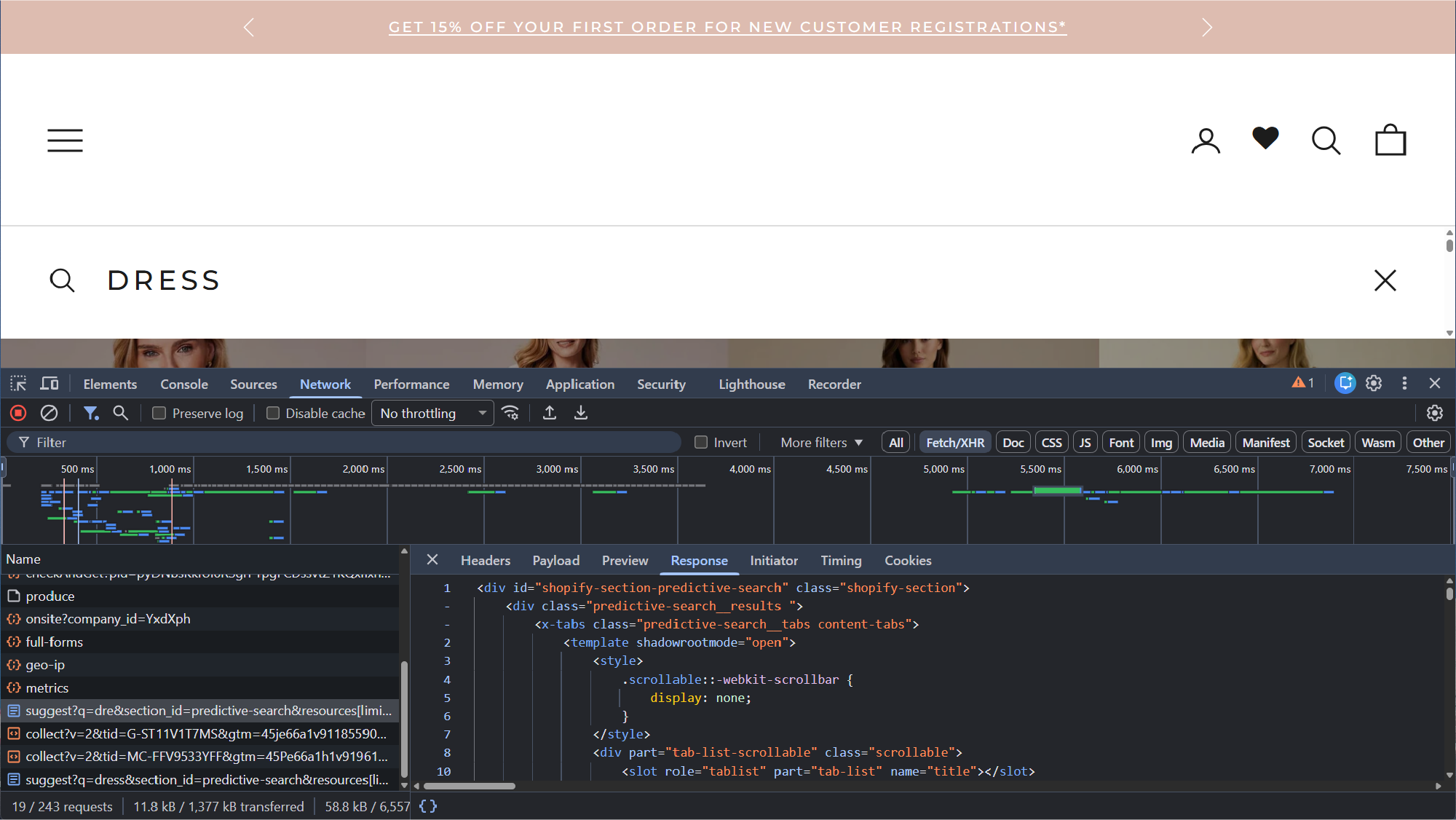
Engine identification. Before any results analysis, every store was checked at the DOM level for the presence of Shopify's Search & Discovery markers and the absence of third-party search app injection. This was done with browser developer tools on a clean session, checking for the predictive-search endpoint signature, the JSON-LD schema variants that Search & Discovery emits, and the absence of competing app script tags. All nine stores resolved to Shopify Native + Search & Discovery. No store in the sample is running Algolia, Boost, Fast Simon, Searchanise, or any other third-party search engine.
This matters because Shopify Native results vary store to store. Variance in this sample is explained by merchant configuration, not by a different engine.
Query slice. Each store was queried with the same set of probes:
- Intent phrases: "wedding guest dress", "occasion dress", "festival outfit", "office wear", "summer wedding".
- Compound and category queries: "floral midi dress", "linen blazer", "cocktail dress".
- Typo cases: "flotal" (one character), "ocasion drss" (two characters), "summr drss" (two characters).
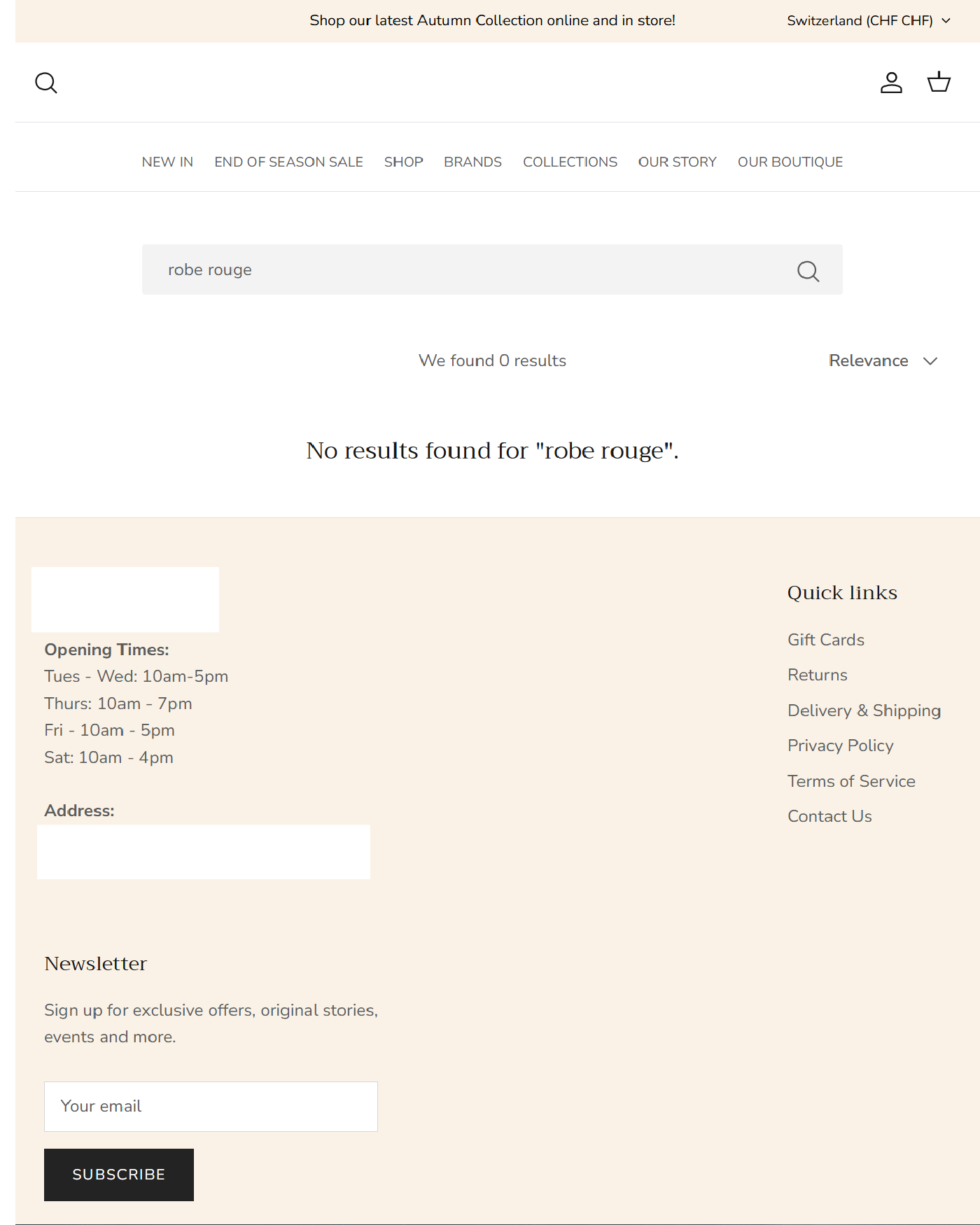
- Cross-lingual cases: "robe rouge" (French, expecting red dresses), "vestido negro" (Spanish, expecting black dresses), against English-language catalogues.
For each query, I captured the result count, the first row of result tiles, and any explicit "no results" UI. Where a store returned an unusual result, I cross-checked the catalogue to confirm whether matching products existed under different vocabulary.
A full data table is not included in this post; it lives in the source research file. What follows is the pattern across the nine stores, not the per-store breakdown.
What Shopify Native does well
It is easy to write a post that lists only the failure modes. That is not the picture. There are queries on which Shopify Native search in 2026 is genuinely competent, and a fashion merchant on a tight budget can ship with it and not embarrass themselves. Three areas in particular hold up.
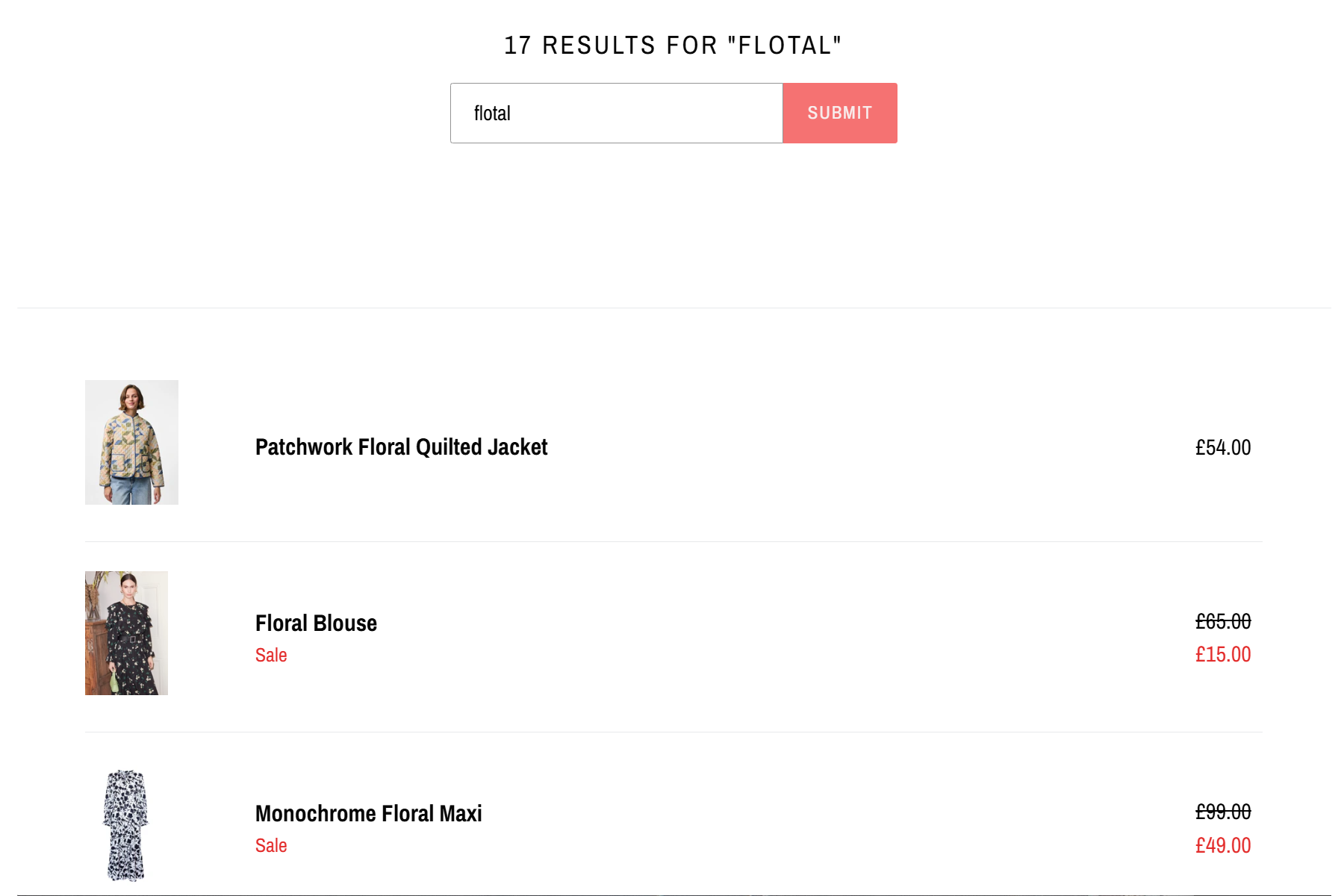
Single-character typo tolerance is solid. Across all nine stores, the query "flotal" (one character missing from "floral") returned a clean set of floral products. On one of the stores the result included a floral tankini top, a floral swing dress, a floral print tea dress, a vintage floral swing cocktail dress, and a floral lace ballet flat, twelve products in all. Other stores in the sample produced between eight and seventeen floral results for the same query. The result counts vary with catalogue size and tagging, but the typo correction itself worked everywhere.
This is worth being explicit about: single-character typo tolerance is not a competitive wedge for any search vendor in 2026. It is table stakes. If a Shopify search app is selling itself on typo correction in a sales call this year, that is a signal about the vendor, not the feature.
Basic semantic relatedness works on common phrasing. Queries that line up with catalogue vocabulary return reasonable results. "Floral midi dress", "linen blazer", and "cocktail dress" all surfaced relevant products on all nine stores. The semantic layer is doing real work here; the same queries on the older keyword-only search would have returned smaller sets and more off-target items.
Zero configuration to install. This is Shopify's structural advantage and it would be dishonest to skip it. Every merchant on the platform gets Native search and Search & Discovery for free, the day they open the store, with no install step. That is a meaningful baseline. Any third-party search app, including Nexology, is making a value claim against this floor.
What the floor does not do is bridge intent to catalogue when the shopper's vocabulary and the merchant's vocabulary diverge. That is the next section.
What Shopify Native does not do: the intent-vocabulary gap
The clearest single result in this study was the wedding-guest case from the opening of this post. On one store, "wedding guest dress" returned zero results. "Occasion dress" returned thirty-eight on the same catalogue.
This pattern, with varying severity, showed up on six of the nine stores in the sample. The query "wedding guest dress" returned between zero and three results on six of the nine, on catalogues that visibly stock dozens of dresses that any human shopper would call a wedding guest dress. The other three stores fared better, but in every case the cause of the better performance was traceable to merchant-side configuration: a synonym group mapping "wedding guest" to "occasion" or "formal", or product tags carrying the phrase verbatim.
This is the intent-vocabulary gap. The semantic engine is good enough to handle reformulations within a single vocabulary, "midi dress" finds "midi-length dress", but it is not good enough to bridge a shopper-intent phrase like "wedding guest dress" to a merchandiser-vocabulary phrase like "occasion dress" without explicit configuration.
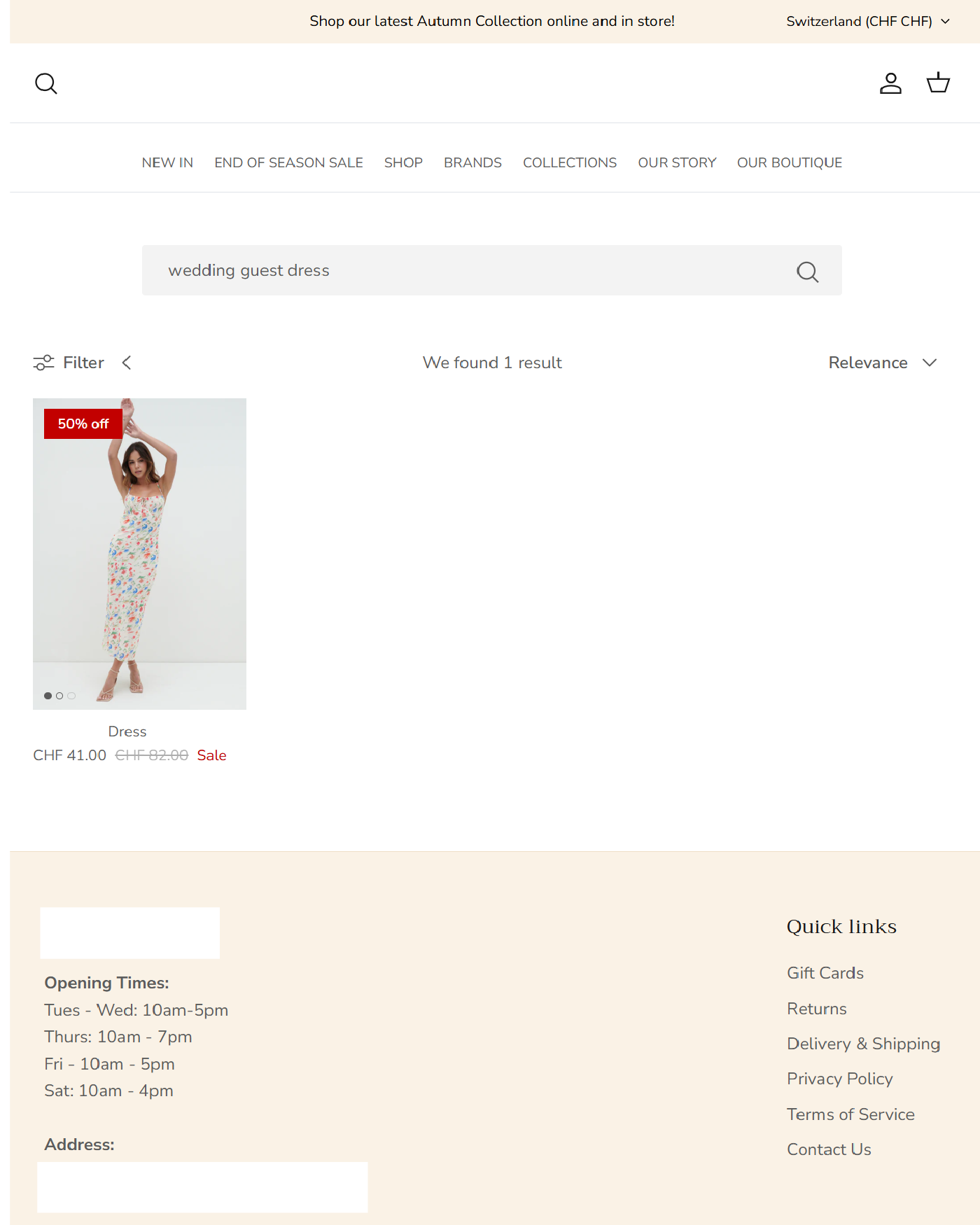
The same gap shows up on "festival outfit" (zero or near-zero results on seven of nine, despite festival-appropriate stock visible in collections), on "summer wedding" (similar), and on "office wear" (better, because the catalogue vocabulary is closer to the query). It is not random. The pattern is consistent with an engine that can paraphrase within a vocabulary but cannot bridge between vocabularies.
Compound typos are partially broken. The query "ocasion drss" (two characters missing across two words) returned mixed results across the sample. Some stores produced a useful set of occasion dresses; others returned a fragment of relevant items mixed with off-target results, and two stores produced effectively no useful results. Single-character typo tolerance is solved. Two-character compound typos are not.
Cross-lingual retrieval is partial and unpredictable. Of the nine stores, seven returned essentially no results for "robe rouge" against their English catalogues. Two stores returned real red items, with the result counts varying widely between them (one returned 25, the other 11). The DOM probe confirmed all nine stores are running the same engine, so the variance is not explained by a different product.
Cross-checking with five more queries on one of the working stores ("rouge" on its own, "noir", "vert", "pantalon", and the Spanish "vestido floral") showed a consistent pattern. The engine carries a small built-in lexicon of common Romance-language colour and garment terms, maps them to English equivalents, and then string-matches the English term against the catalogue. The lexicon is real, but it is narrow, and its output depends entirely on the catalogue. "Vert" on one of the working stores returned a mix of green, navy, and brown items: the mapping fires but precision is poor. "Pantalon" returned a clean set of trousers, because every trouser in the catalogue has the literal word "trousers" in its title. "Robe" by itself returned mostly items from a brand whose name starts with "Robe-" rather than French dresses.
The mechanism explains the seven zeros too. Even when the engine maps "rouge" to "red", it still needs to find products with the literal word "red" in indexed metadata. Stores that describe their items as "crimson", "burgundy", "wine" or by Pantone code never trigger the match. Coverage is therefore catalogue-dependent: whether a store works on a French query is a function of how literal its English product copy happens to be, not of anything the merchant or shopper can control.
A merchant who actually needs reliable multilingual search cannot build on this. The lexicon covers Romance-language colour and garment terms in a limited band; Japanese, Arabic, Hindi, and intent-led queries in any language are out of scope. There is no extension path beyond what Shopify has shipped.
The 200,000 product cap, 25-filter ceiling, and ranking opacity affect a smaller fraction of the sample directly but show up at the edges. Two of the nine stores are within an order of magnitude of the product cap; both have product expansion plans in 2026 that will run them into it. Six of the nine have filter sets at or near the ceiling on their main collection pages, with no headroom for new attributes. Ranking opacity affects every store, in the sense that none of the nine merchants I could speak to could explain why a given product ranked where it did.
None of these are exotic limitations. They are the everyday experience of running a mid-market fashion store on Shopify Native in 2026.
What this means for fashion merchants
The headline finding of this study, said plainly, is that fashion merchants on Shopify Native are losing intent-driven searches they cannot see in analytics.
A search for "wedding guest dress" that returns zero results is not visible as a lost sale in standard Shopify reporting. It shows up as an exit, or a refined query, or a session that ended on a search page. There is no funnel column called "intent-phrase searches your engine could not bridge". This is the silent failure mode of opaque search: you measure what the engine returns, not what the engine failed to return.
Three signals suggest a fashion merchant should treat Shopify Native search as a stopgap rather than a destination:
Your catalogue is growing past 25,000 products, or you are adding new categories that bring new shopper vocabulary. Synonym-group maintenance grows superlinearly with catalogue scope. At some point the merchant is doing the engine's work by hand.
You sell into more than one language, or expect to within the year. Shopify Native's cross-lingual support is real but narrow: a built-in lexicon of common colour and garment terms in Romance languages, only useful when the catalogue happens to use literal English vocabulary. Coverage is unpredictable across stores and falls off entirely for non-Romance languages and intent-led queries. Genuine multilingual retrieval needs an engine that embeds product attributes in a multilingual semantic space, independent of the literal words used in product titles.
You sell fashion-category items where shopper intent vocabulary diverges from merchandiser vocabulary. This is true for occasion-led categories (wedding guest, festival, party, holiday), for style-led categories (90s, coastal grandmother, quiet luxury), and for fabric and silhouette terms that shoppers use but catalogues do not consistently tag.
For merchants outside those three signals, Shopify Native is a reasonable floor. For merchants inside any of them, the floor is leaking.
A separate but related point: the opacity of Shopify Native makes the leak hard to triage. A merchant cannot ask the engine why "wedding guest dress" returned nothing, because the engine does not surface its reasoning. The merchant can guess at synonym configuration as a remedy, but cannot inspect what the engine is doing. Any upgrade path that does not address this opacity is replacing one closed system with another.
What the fix actually is
The fix is not "a better search app", generically. The fix is search that bridges shopper intent to catalogue vocabulary without forcing the merchant to maintain synonym tables by hand, that handles multilingual retrieval natively rather than through configuration, and that exposes its reasoning so a merchant can inspect and trust the results.
Nexology is the product I am building toward that fix. Specifically: a fashion-trained image embedding model gives the recommendation surface visual relevance from first sync, a multilingual text embedding model handles cross-lingual queries from a single index, and reason codes are returned on every API response so the merchant can see why each product ranked where it did. Pricing is flat: $99/mo on the Starter tier, with semantic search included rather than gated behind a premium plan.
If you want to test it on your own store, Nexology is free to install from the Shopify App Store. The trial is fourteen days and there is no setup call required. If you would rather see it on a demo first, you can book a short demo and I will walk you through it on a clone of your catalogue.
The empirical study above is not a sales pitch in disguise. The data is the data, and Shopify Native search is good at what it is good at. But on fashion catalogues, in 2026, the intent-vocabulary gap is the single biggest lever a merchant can pull, and it is the lever Shopify Native does not pull on its own.
If this matches what you are seeing on your own store, you can install Nexology free for fourteen days and check the same queries on your catalogue inside the trial window.
14-day trial · No setup call · Cancel any time